Tuesday, September 29, 2009

Moisturizers: Do's and Don'ts


The most important asset to healthy skin is a good moisturizer. But which ones are best? Which ones are harmful? First of all, I do not use anything that has been tested on animals because it is unethical. That is besides the point. You should stay away from anything that is a mainstream, well-known brand and go towards very natural ingredients.

The big brand products are usually cheap, therefore made with the cheapest ingredients. These include chemicals and petrochemicals that you need to stay away from. Two harmful and even cancerous ingredients include "mineral oil" and anything that ends in "parabens". These chemicals have been named carcinogens by the Cosmetic Safety Database (CSD). Also, even though it should be obvious, PLEASE stay away from moisturizers with the warnings that read, "WARNING! HARMFUL IF SWALLOWED OR INHALED. CAUSES IRRITATION TO SKIN, EYES AND RESPIRATORY TRACT". If it's harmful for you to ingest, it probably is not the best thing for you to be applying to your skin. Remember, it is the largest organ in your body.

So now you know what to look out for. Well here is what you should search for. Anything natural. Avocado oil, Shea Butter, and Olive oil are just a few that will moisturize your skin naturally and effectively. Their most important component? Natural Ingredients.

Think about what you are putting on your skin. Would you rather it be some lab-developed chemicals that cost next to nothing? Or would you want extremely natural ingredients that have not been processed at all? I think the answer is obvious. Do not neglect your skin, especially during the season change and winter. It is the key to healthy skin.

Some helpful websites:
http://naturalskinhealth.com/natural-skincare/
http://naturalskinhealth.com/blog/best-face moisturizer/
http://www.ehow.com/video_4756514_what-best-moisturizer-face.html

Friday, September 25, 2009

Safe Tan: is there Such a Thing?


Employees at tanning salons are extremely tan. I am sure that is an observation that every regular "bed-tanner" has made. However, if you ask them how many times they use the beds, their answer might surprise you. Many of them use spray tanning, a so-called safer way to tan.

Sorry to burst your bubble, but spray tanning is not 100% healthy either. Like any skin care product, it contains chemicals that have not been tested by the Federal Drug Association (FDA). Excessive exposure to these chemicals create allergic reactions such as rashes, swelling, and even flu like symptoms.

Many assume that the spray isn't harmful because of the tested, main ingredient called dihydroxyacetone (DHA). Its just a brown sugar-like chemical that is the main coloring agent. It does not do any harm to the skin, however is is not supposed to be ingested. Now, think about the spray tanning procedure. The spray has to be ingested through the mouth, nose, eyes, and in some cases the genitals. That does not sound very healthy to me.

Despite all of this, a spray tan is healthier than UV ray tan. So if you must stay tan, here is a video that shows the process and gives great information on how to keep your tan for longer.
http://video.about.com/beauty/Watch-Airbrush-Tanning.htm

Monday, September 21, 2009

Does Your Sunscreen Work?


As everyone knows, it is so very important to wear sunscreen while out in the sun. But what kind do you wear? Which one is really working? These are questions that are not asked enough. People just go and buy bottles that read "85 SPF" or "15 SPF with tanning oil included".

In truth, an SPF of 30 or 45 is ideal. SPF stands for Sun Protection Factor. Anything that reads above that is not doing anything more than that, but costing much more. Anything lower than 30 is not doing anything at all to protect your skin from UV rays other than keep it from turning red. Remember--a tan outside is just as bad as a burn. So do not waste your money on bottles of lotion that are not worth it, check out this website.

http://www.ewg.org/whichsunscreensarebest/2009report

This is the 2009 report of the best sunscreens and why. Many think that the only ones that work are the cliche "lifeguard sunscreen"--the stuff that stays white on your skin and leaves a residue. That is from the zinc and titanium in those certain sunscreens. Even though they do work extremely well, there are some that have the same effects but without the mess to clean up. They are non-mineral sunscreens, so if you have a problem with looking like a nerd but staying safe, keep an eye out for these.

Wednesday, September 16, 2009

SUNBURN: Dangerous Even When the Sun Is Not Present


The average person worries most about getting a sunburn at the beach and totally neglects their skin on an overcast day when could be taking a jog, a hike, or any other daily outdoor activity. The scary truth is that your skin is still at a risk of getting burnt. A sunburn comes from the Ultra Violet Rays of the sun, not the light or heat. These rays are present whenever there is daylight, even if there is a severe thunderstorm. The severity of the burn is obviously going to be different at the beach than at the park on a gloomy day, but there is still a risk.
And if that was not enough, you can also get a sunburn through your clothing. Many people go to the beach and wear clothing, thinking that they are keeping their skin from the UV rays. However, the light clothing is only serving as a thin buffer. Sunburn can still occur and more importantly, the skin is still being harmed by the UV rays of the sun. This also applies to an overcast day.
There is special clothing that many companies produce and for an inexpensive price. Stores such as Eastern Mountain Sports, Dick's Sporting Goods, Sports Authority, etc. are just a few examples of providers that hold this type of clothing. Other companies specialize in this type of clothing and can be ordered online. Bathing suits are also available and a good investment. See the links below.

http://www.coolibar.com/index.html?

s_kwcid=sun%20screen%20clothing%7C2278011524http://www.stingray.com.au/products/default.asp?spc=1&gclid=CP28sdXs9pwCFc5L5QodxmlobA

http://www.llbean.com/webapp/wcs/stores/servlet/LLBSearchDispatch?storeId=1&catalogId=1&langId=-1&init=1&freeText=tropicwear&qs=3005060&trkid=21196S62429730

Next Post to come...."Does Your Sunscreen Work?"

Tuesday, September 15, 2009

The VERY negative effects of UV Tanning


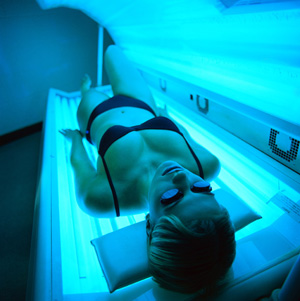
Did you ever wonder what laying in that bed of Ultra-Violet rays would do to you? Other than giving you a nice tan, your skin is prematurely aging, your eye sight is diminishing, your immune system is weakening and you are at a greater risk of getting skin cancer and because of a recent study, the risk is significantly higher than in previous years. The International Agency for Research of Cancer (IARC) has made tanning beds, or UV tanning, in Group-one of their rating system for carcinogens (cancer causing factors). This means that the beds are considered one of the most harmful forms or radiation.

The reason that action was taken against the tanning bed phenomenon is because the rate of skin cancer is on a considerable incline in European countries. This seems a little odd because of the lack of actual sun exposure compared to other nations. However, because of this deficiency, tanning companies found it necessary and profitable to create an abundance of their companies in these “sunless” countries. Most of the people using the beds are of ages 30 and under. According to the study by the IARC "the risk of skin cancer jumps by 75 percent when people start using tanning beds before age 30". 75 percent is a huge and very scary number. Another scary number is 8,650. That is how many people die of Melanoma every year. Melanoma is the most deadly form of skin cancer and it is most commonly formed because of UV tanning.

One of the most important things to do is to be checked by your dermatologist. A full body scan to look for abnormalities, moles and freckles can save you. My sister was checked and discovered possible early signs of melanoma on one of her moles. She is 17 years old. She has only been UV tanning a select few times before prom and other similar things. She is completely fine now because everything has been removed due to that visit to the dermatologist. Getting a fake tan seems to be pretty silly when it will most likely result in all or some of the above mentioned conditions. The Melanoma Foundation, IARC and other organizations are taking strides in increasing awareness of these issues. Because the summer season is winding down, and that lovely sun will be disappearing behind the fall leaves and winter snow, please stick to a bronzer or daily tanning lotion. Do not UV tan!

More questions? Check out this link! http://www.skincheck.org/

Search This Blog